
Your first powerful car: what changes behind the wheel and where to start
What changes behind the wheel of a car doing 100 km/h in three seconds: wet asphalt, cold tyres, drive modes, and entry thresholds across the Masons fleet.
--- slug: your-first-powerful-car title: "Your first powerful car: where to start behind the wheel" description: "What changes behind the wheel of a car doing 100 km/h in three seconds: wet asphalt, cold tyres, drive modes, and entry thresholds across the Masons fleet." h1: "Your first powerful car: what changes behind the wheel and where to start" --- The difference between an ordinary car and one that reaches 100 km/h in three seconds doesn't show up where you'd expect it. You expect it on a straight or at the lights. It actually shows up coming out of a corner on a wet road, when changing lanes on the motorway, and in the moment when your right foot makes its usual movement and the car responds twice as hard as usual.
In short. On the first day, what matters isn't performance but getting used to the car: cold tyres and wet asphalt change how a powerful car behaves more than any suspension mode does. Start in the calm setting, with stability control switched on, and don't experiment on wet surfaces. The entry threshold varies widely across the fleet — from eight seconds to 100 km/h down to three — and rear-wheel-drive cars demand more careful throttle work than all-wheel-drive ones.
What changes when there's a lot of power
Three things, and none of them is about top speed.
The cost of a mistake with your right foot. In a car with a modest engine, a sharp press of the accelerator gives you acceleration. In a powerful car, the same movement can give you wheelspin, the electronics kicking in, and a small scare. Learning here is about metering the throttle, not about courage.
Speed builds up without you noticing. On a smooth motorway, a powerful car picks up pace quietly and effortlessly, and the number on the dial creeps past your intended speed on its own. This is the main practical risk of a first drive — not losing control, but an ordinary fine.
The power delivery is uneven. Almost all the petrol engines in the fleet are turbocharged, judging by the badges on the listings: TwinTurbo, Biturbo, Turbo. A turbocharged engine's power delivery isn't linear: at low revs the turbo hasn't yet reached its working range, and then the surge follows. Modern setups — two smaller compressors, separate exhaust channels, an electrical boost to the onboard system — smooth out this gap but don't remove it entirely. So the same amount of pedal travel at two different points in the rev range gives a different result.
The first half hour: cold tyres and wet asphalt
The most underrated factor on a first drive is tyre temperature. Cold rubber grips worse than warm rubber, and the difference is noticeable over the first few kilometres regardless of drive type or power. Hence a simple rule: you drive gently for the first half hour not out of caution for its own sake, but because grip is genuinely lower during that time.
Wet surfaces add a second layer to this. In Prague it's compounded by the city's specific features: cobblestones in the centre, tram rails, wet metal manhole covers. On wet cobblestones and rails, traction disappears both predictably and suddenly at once, and a powerful car reacts to this more sharply than a modest one.
The third factor is size and visibility. A low seating position changes your sense of distance to the kerb, and a wide body changes your sense of distance to the next lane. Five minutes spent adjusting the seat, steering wheel, and mirrors before you set off do more for you than any mode in the menu.
The winter part of this is regulated by law: from the start of November to the end of March, the requirement for winter tyres kicks in whenever the road surface is actually — or is expected to be — covered in snow, ice, or frost, and a tyre only counts as a winter tyre with a tread depth of at least four millimetres. A powerful car on the wrong tyres in such weather is more dangerous than an ordinary one in exact proportion to how much more traction it has.
There is also a fourth factor that people think about last — braking. A car that accelerates quickly also needs different planning for slowing down: a following distance that felt sufficient in an ordinary car gets eaten up by a powerful one in the second before your foot even reaches the brake. This shows up more often in dense city traffic than on the open road, and the fix isn't technique but the habit of keeping more space ahead of you.
It's also worth choosing your first route in advance. The calmest option out of Prague is the short motorway stretch toward Plzeň: around eighty kilometres of smooth road with no known permanent restrictions, where you can get used to the car's size and pedal response before it ends up on a narrow street in the centre.
Drive modes: what they actually switch
The menu of a powerful car usually has three groups of settings, and it's worth not confusing them.
Suspension. The comfort setting absorbs bumps more softly, the sport setting holds the body more firmly. On cobblestones and broken asphalt, the comfort mode isn't just more pleasant — it's more useful: the wheel loses contact with the road less, which means it transmits traction better.
Engine and transmission response. Sport modes sharpen the throttle response and shorten the shifts. On the first day this works against the driver: the same amount of foot movement produces a bigger result.
Drivetrain and electronics. Some all-wheel-drive cars have a mode where the front axle disengages and the car becomes rear-wheel drive. That's a setting for a closed circuit, not for a first drive around the city. Stability control shouldn't be switched off at all on the first day — it doesn't stop you driving fast, it stops you driving into a wall.
A separate note on launch control. It's a standard, factory-calibrated function, and the myth that using it once damages the transmission isn't true. What actually wears it down is repeated launches without a cooling pause, using it with a cold transmission, and using it with a worn clutch. On the first day of a rental it simply has no job to do.
The fleet, broken down: entry threshold
Power is barely listed anywhere in the specifications on the fleet's listings, but 0–100 km/h acceleration and drive type are. For assessing the entry threshold, this pair is enough: drive type determines how the car reacts to the throttle on a slippery surface, and acceleration determines how sharply.
| Group | Cars in the fleet | Drive | 0–100 km/h |
|---|---|---|---|
| Gentle entry | Mercedes-Benz A-Class AMG Line | front-wheel | 8.1 s |
| Gentle entry | Audi A5 Cabrio, BMW X6 xDrive | all-wheel | 6.3–6.5 s |
| Mid-range | Mercedes-Benz S 350 d, BMW X7 xDrive40d | all-wheel | 5.9–6.2 s |
| Mid-range, rear-wheel drive | BMW M2 G87, Mercedes-AMG C63 Coupé, Porsche 911 Carrera | rear-wheel | 4.0–4.2 s |
| Requires experience | BMW X5 M, BMW M4 Competition, BMW M3 Competition | all-wheel | 3.5–3.8 s |
| Requires experience | BMW M8 Competition, Mercedes-AMG GT 63 S, BMW M5 Competition Manhart | all-wheel | 3.0–3.2 s |
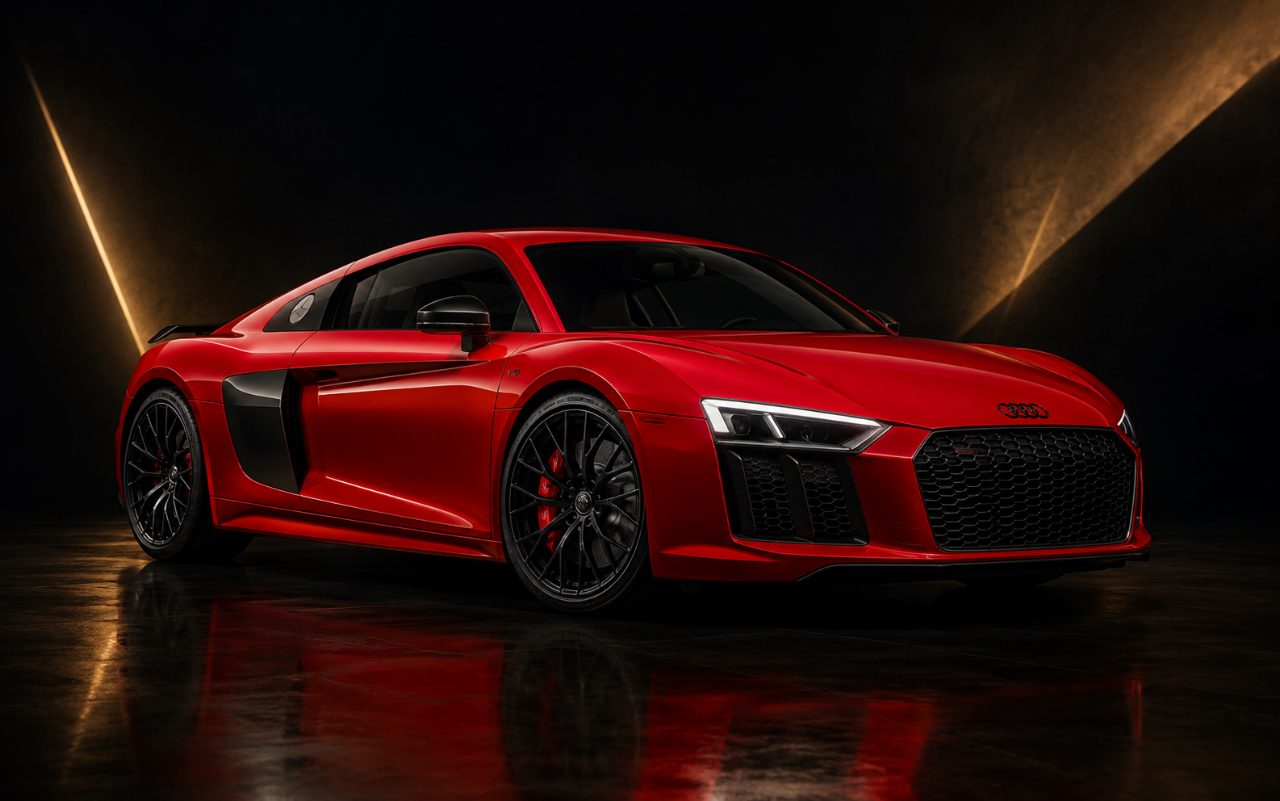
| Experienced drivers only | Audi R8 V10, Chevrolet Corvette C8 | rear-wheel | 2.9–3.1 s |
| Special case | Tesla Cybertruck | all-wheel | 4.1 s |
Two rows deserve a comment. The rear-wheel-drive cars in the "experienced drivers only" group are the combination people misjudge most often: power goes to one axle, acceleration comes in under three seconds, and on a wet surface such a car's margin of grip is minimal. The electric pickup stands apart because an electric motor delivers full torque from zero rpm: acceleration starts with no delay and no build-up, which is something you get used to separately.
The entry threshold isn't a restriction or a ranking. It's a pointer to which car to start with if you don't have much experience with powerful cars, and which to move to afterward. The full list of the fleet is in the fleet section.
What Czech roads require
The rules here are stricter than a visitor might expect, and in two respects stricter than in neighbouring countries.
Alcohol: there is no permitted threshold at all — any amount is prohibited. It isn't 0.3 or 0.5 per mille, as in some neighbouring countries, but zero — and the rule is the same for locals and visitors.
Speed: 50 km/h in a built-up area, 90 outside a built-up area, 110 on an expressway, 130 on a motorway. Within the built-up section of a motorway, the limit is 80. A powerful car reaches any of these figures without effort, and that's exactly the situation where speeding happens not out of recklessness but out of inattention.
Accidents: you must call the police if anyone is injured or if material damage to any of the vehicles involved exceeds 200,000 crowns — this threshold has been in effect since 1 July 2025. For a premium car, that threshold is reached faster than people tend to think: a damaged bumper with sensors and a headlight on a car of this class can easily approach the amount at which handling things without the police is no longer an option. Insurance conditions and the concept of excess are described in the FAQ; confirm the details for a specific car when booking.
What not to do
Switch off stability control on the first day. Its job isn't to get in your way — its job is to protect you.
Test acceleration on wet cobblestones. Grip there is lower than it looks, and it disappears without warning.
Start with sport modes. A sharp throttle response is something you take on after you've gotten used to the car's size.
Switch an all-wheel-drive car into rear-wheel-drive mode on a city street. That's a setting for a closed circuit.
Focus on top speed. There's nowhere to use it in Czechia: the motorway limit is 130 km/h, and it's the same for every car in the fleet.
Get behind the wheel right after a flight. Fatigue and an unfamiliar car are a combination worth spacing out by at least a few hours.
Assume power makes up for tyres. In winter and on wet surfaces, it's grip that decides, not power.
FAQ
Do you need experience to rent a powerful car?
The rental's formal requirements are a minimum age of 21 and at least two years of driving licence history; conditions differ for drivers under 21. There's no separate experience requirement specifically for powerful cars, but the entry threshold varies widely across the fleet — from eight seconds to 100 km/h down to three — so it's more sensible to start somewhere other than the extreme end of that range.
What changes on a wet road compared with a dry one?
Your margin of grip, and a powerful car uses it up faster. On a wet surface, the same throttle input that works on a dry one can cause wheelspin and trigger the electronics, and on cobblestones and tram rails traction can disappear suddenly. The practical takeaway: on wet surfaces, work the throttle more smoothly and keep a bigger following distance.
Rear-wheel drive or all-wheel drive for the first time?
An all-wheel-drive car is more predictable: torque goes to all four wheels, and wheelspin on takeoff or coming out of a corner happens less often. A rear-wheel-drive car requires more careful metering of the throttle, especially on wet surfaces and with cold tyres. The fleet has both, with comparable acceleration figures, so the choice here has nothing to do with the car's level.
Does launch control damage the transmission?
As a general claim, this is a myth: the function is a standard feature, designed by the manufacturer for repeated launches within factory tolerances. Wear increases from the pattern of use — repeated launches with no cooling pause, use with a cold transmission, a worn clutch. On the first day of a rental, the function simply has no practical purpose, so it makes more sense to get to know the car without it.
What is the alcohol limit in Czechia for a driver?
Zero. Czech law sets no permitted per mille figure — driving with any amount of alcohol in your system is prohibited, and so is drinking alcohol while driving. The rule is the same for locals and visitors alike. Neighbouring countries have higher limits, and the habit of thinking "a little is fine," carried over from another country, leads to consequences in Czechia.
When is it mandatory to call the police after an accident?
If anyone is injured, if someone else's property or road infrastructure is damaged, or if material damage exceeds 200,000 crowns on any of the vehicles involved — a threshold in effect since 1 July 2025. For a premium car, that amount is reached faster than people expect, so if in doubt, it's more sensible to call the police and contact the rental company at the same time.
Ready for the next drive?
Choose the exact car and dates. The Masons team confirms availability and the final price personally.