Which car for which rental package: choosing by daily mileage
The three rental packages differ in included mileage and excess. Here's how to pick one for city driving, a long day trip, or a multi-day journey.

--- slug: which-car-for-which-package title: "Which car for which rental package" description: "The three rental packages differ in included mileage and excess. Here's how to pick one for city driving, a long day trip, or a multi-day journey." h1: "Which car for which rental package: choosing by daily mileage" --- Booking usually starts with the car, and the terms get checked last. With mileage, the order is reversed: work out how many kilometres a day the trip will actually take, and only then pick the package and the body style to match. A miscalculation here tends to surface on the last day, when it's too late to change anything.
In short. There are three packages: the base one includes 250 kilometres a day, the mid-tier 350, and the top one has no mileage limit at all. City driving and a one-hour radius around Prague fit within the base package, a single long there-and-back trip calls for the mid-tier, and a multi-country trip or a route with no fixed turnaround point calls for the top one.
How the packages differ from each other
The difference between the three packages runs along two lines at once, and the second one gets noticed less often.
The first line is included mileage. The base package gives 250 kilometres a day, the mid-tier 350, and the top one removes the limit altogether. Kilometres beyond the included allowance are charged separately, at a rate that depends on the model — so an underestimated route costs noticeably more on an expensive car than on a compact one.
The second line is the excess — the portion of any possible damage that stays with the renter. The higher the package, the lower the excess: the base package leaves the highest threshold, the top one the lowest. For a trip around the city this is a secondary concern; for a winter motorway or mountain roads, it isn't.
The refundable deposit, by contrast, isn't tied to the package: its amount is set by the model. Exact figures for both lines are published on the listing of the chosen car and in the FAQ section — deliberately left out here, because they change while the text stays the same.
How to calculate daily mileage, not total mileage
The calculation is done per rental day, and that's the first place people get it wrong.
The method is simple. Add up every leg of the route, including the return trip and local driving, divide by the number of days, and compare the result with the package's included mileage. City driving adds up more than it seems: the drive to the hotel, dinner in another neighbourhood, a stop at the filling station before returning the car — several dozen kilometres accumulate in a day even without leaving Prague.
The second common mistake is uneven distribution. Three rental days with one long 400-kilometre trip and two city days still fit within the base package overall, since the average works out to around 150 a day. There's no need to plan around the peak day — what counts is the total for the whole term.
The third is the return leg. Distances to popular destinations are usually quoted one way: Plzeň is about 88 kilometres via the D5 motorway, Karlovy Vary about 115 via the D6 with stretches of ordinary road, Brno almost 197 via the D1. You'll have to drive back the same way, so the figure needs to be doubled.
The base package: city and a one-hour radius
250 kilometres a day covers almost everything that happens around Prague without an overnight stay.
Plzeň there and back is about 176 kilometres — comfortably within the limit. Dresden via the D8 through the Krušné hory is about 139 kilometres one way, roughly 280 in total, which already exceeds the base allowance in a single day. Karlovy Vary with the return trip is about 230 — tight, with no room for a detour or a side trip to Loket.
Any car in the fleet suits this scenario, and the choice should be made on other criteria — passenger numbers, the season, where the car will spend the night. The base package is exactly where it makes sense to take something that would be excessive on the motorway: a coupé, a convertible, a compact hatchback.
The programmes in the Experiences section are a separate case: their routes are put together around the date and the weather, and the mileage isn't fixed in advance, so the package is discussed together with the programme rather than chosen based on this article.
The mid-tier package: one long leg there and back
350 kilometres a day is exactly the volume that covers most one-day trips to neighbouring regions.
Český Krumlov via the D3 and then road I/39 is about 160 kilometres one way, so about 320 there and back. The Krkonoše via the D11 and mountain road I/14 is about 125–130 one way, meaning about 260 with the return trip, plus driving around the resort. Dresden as a single-day trip fits here too.
Brno no longer fits within this volume: 197 kilometres via the D1 one way add up to nearly 400 in a day. If the Brno trip is a single day, the mid-tier package doesn't cover it; if it includes an overnight stay, the average over two days falls back within range.
The logic for choosing a car changes here. A long motorway leg means two to three hours in the seat at a stretch, and this is where the fleet's diesel cars give a practical advantage: fewer fuel stops and steadier consumption at speed. It's worth looking toward the larger body styles in the fleet section, rather than the fastest models.
The top package: several countries or an open route
The unlimited-mileage package is needed in two cases, and both are about uncertainty rather than distance.
The first is a route that isn't fixed in advance. A multi-day trip with overnight stays in different towns, with no planned return point, almost always exceeds 350 kilometres on at least one of those days and needs recalculating on the fly.
The second is a trip outside Czechia. Vienna via the D1 and D52 through Mikulov, Linz via the D3 with a detour around an unfinished section, Nuremberg via the D5 to Rozvadov — each of these destinations comes to 300–400 kilometres one way, and the return leg often falls on a different day.
One caveat matters here that has nothing to do with mileage but overrides the whole calculation: crossing the border is only possible with prior written approval and extended insurance cover. The base cover applies within Czechia. This needs to be confirmed when booking, not once the trip has already started.
The fleet by daily mileage
The table breaks the fleet's 23 cars down by a single criterion — how comfortably a model handles a high daily mileage. Body style and engine matter more here than performance.
| Fleet group | Models | Fuel | Comfortable daily mileage |
|---|---|---|---|
| Compact hatchback | Mercedes-Benz A-Class AMG Line | diesel | any, including the maximum |
| Diesel SUVs and the flagship saloon | BMW X6 30d xDrive, BMW X7 xDrive40d, Mercedes-Benz S 350 d 4MATIC | diesel | long legs with minimal stops |
| Petrol SUVs | BMW X5 M Competition, Mercedes-AMG G63 | petrol | medium legs; higher fuel consumption on the motorway |
| Saloons and four-door coupé | BMW M3 Competition (two cars), BMW M5 Competition, BMW M5 Competition Manhart, Mercedes-AMG GT 63 S | petrol | long trips for two or four |
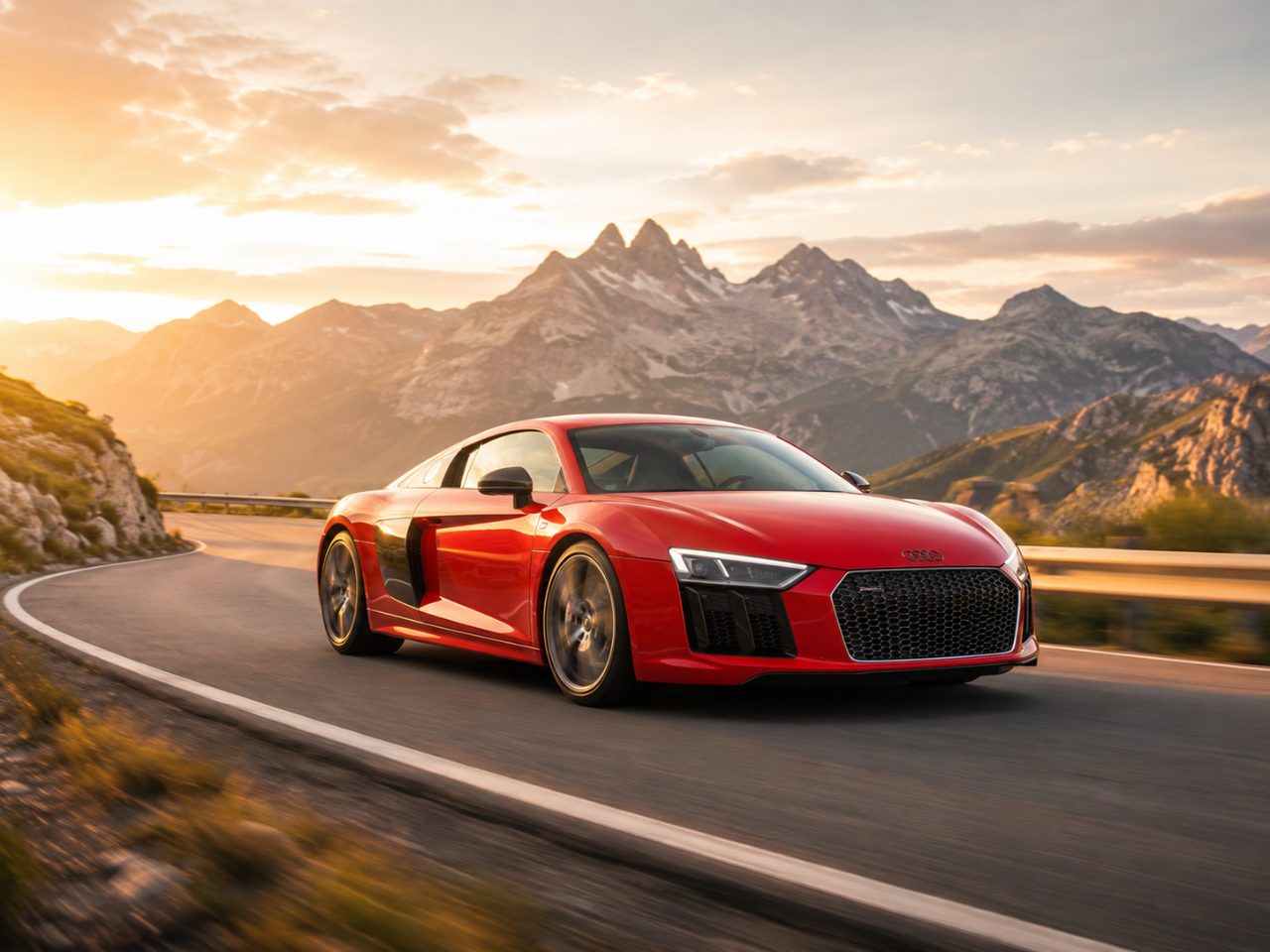
| Sports coupés | BMW M2, BMW M4 Competition, BMW M4 Competition G82 Akrapovič, BMW M8 Competition, Mercedes-AMG C63, Porsche 911 Carrera, Audi R8, Chevrolet Corvette C8 | petrol | short trips and a day's radius |
| Convertibles | Audi A5 Cabrio, BMW M4 Competition Cabrio G83, Porsche 911 Cabrio | petrol | seasonal routes, moderate distance |
| Pickup | Tesla Cybertruck | electric | depends on the charging plan along the route |
The row for the electric pickup is fundamentally different from the rest: what limits it isn't the package but the charging infrastructure along the route, and a trip like this needs to be planned around stations rather than kilometres.
Another point the table makes: the groups suited to high mileage barely overlap with the groups suited to central Prague. A trip split between city days and road days is therefore usually settled not by hunting for one universal car, but by an honest choice of priority — what matters more on those specific dates.
What changes with the package besides the number
The package affects three things beyond mileage, and they usually come to mind at an inconvenient moment.
Excess. The top package lowers the liability threshold most noticeably — a point in favour of it for a winter trip, mountain roads, or a route with a night-time drive, where the risk of minor damage is objectively higher.
Rental days. The rental is calculated in 24-hour periods from the moment the car is handed over. Returning it after a new period has started counts as a new day under the tariff — and along with it, a new portion of included kilometres that will go unused.
Fuel and road charges. The car goes back with the same amount of fuel it had at pickup, and motorway vignettes, toll sections, and parking along the route are the driver's responsibility. None of this is tied to the package, but on a long route it weighs just as much.
Mistakes when choosing a package
Calculating from the map instead of the road. The navigation app shows the direct route, while the real one includes detours around unfinished sections — the gap in the D3 near Kaplice, for instance, is covered via ordinary road I/3 through built-up areas.
Taking the top package "just in case" for a city trip. If the car spends three days parked at the hotel and makes one trip to Karlovy Vary, the removed mileage limit simply goes unused.
Forgetting the pickup and return days. The drive from the airport, the trip to the hotel, and the return — these are kilometres that rarely make it into the initial calculation.
Looking only at mileage and ignoring the excess. The two lines work independently: for a winter trip to the Krkonoše, a lower excess often matters more than an extra hundred kilometres, while for three city days in June, it's the other way around. Choosing on only one of the two parameters is almost always half a decision, and the other half surfaces the moment something goes wrong in a parking lot.
Planning a cross-border route before getting approval. An unlimited-mileage package by itself doesn't authorise crossing the border — that's a separate condition, and it needs to be confirmed in advance.
FAQ
How do I know which package I need if the route isn't finalised yet?
Work from the maximum you're confident you won't exceed. Add up the expected legs of the route together with the return trip, add roughly 30–40 kilometres a day for driving around town, and divide by the number of rental days. If the result is comfortably below 250, take the base package; if it hovers around 300, the mid-tier is more reliable than risking an overage charge.
Is mileage counted per day or as a total for the whole rental?
As a total for the whole rental term, though the allowance accrues per 24-hour day. So a single long trip doesn't push you past the package limit as long as the car sits idle on the other days. Three days with 250 included kilometres each give a total allowance of 750, and you can distribute it however you like within the term — what matters is the total at the moment the car is returned.
What happens if I drive more than the package includes?
Kilometres above the included allowance are calculated separately at a rate tied to the specific model and added to the final amount when the car is returned. The rate for sports models is higher than for compact ones, so extra mileage on a powerful car costs noticeably more. The exact rate for the chosen car is confirmed when booking.
Can I drive the rental car to Germany or Austria?
Only with prior written approval and extended insurance cover — the base cover applies only within Czechia. Removing the mileage limit doesn't by itself open the border; that's a separate rental condition. It's worth planning a cross-border route before booking, so the approval and the extended cover can be built into the contract in time.
Which car in the fleet is most comfortable for a 400-kilometre day?
Diesel models with a large body: the BMW X6 30d and X7 xDrive40d SUVs, and the flagship Mercedes-Benz S 350 d saloon. They have steady fuel consumption at motorway speed, fewer fuel stops, and seating designed for several hours at a stretch. Sports coupés don't lose out over this distance on speed, but on driver and passenger fatigue.
Does the choice of package affect the refundable deposit when picking up the car?
Not directly: its amount is set by the car's model, not by the package. The package changes the excess — the portion of any possible damage that stays with the renter. The top package lowers this threshold more than the others, which makes sense for winter and mountain routes. The conditions for a specific car are confirmed when finalising the booking.
Ready for the next drive?
Choose the exact car and dates. The Masons team confirms availability and the final price personally.